
Communicated to colleges
End of September 2026The Grand Challenge and all ten Sub-Challenges go out to partner institutions.
One Grand Challenge. Ten Sub-Challenges. Greenzy is bridging the gap between academic learning and industry-readiness in Protected Cultivation, Hydroponics, and Controlled-Environment Agriculture — starting with the engineers who'll build its next systems.
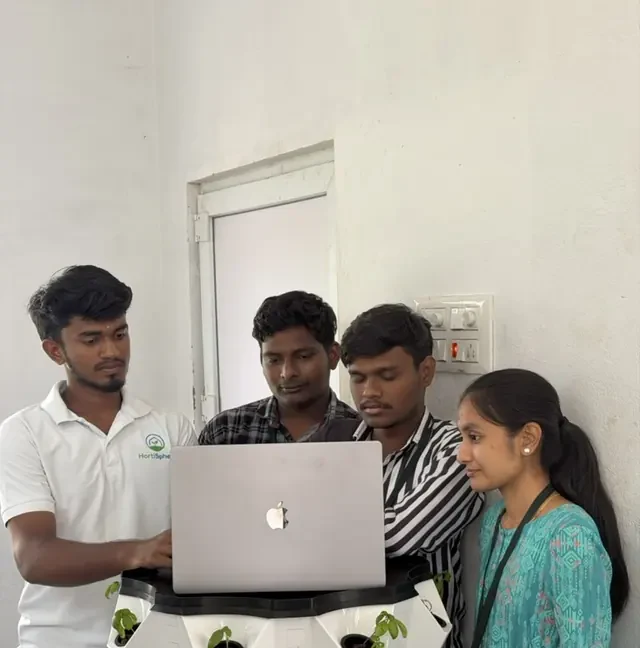
Farmers, agronomists, and institutions can see where Controlled-Environment Agriculture is headed. What's scarce is the engineering talent to build the sensing, automation, and diagnostic systems it actually needs.
The Greenzy Agri Hackathon closes that gap directly: one Grand Challenge that asks for a working prototype, ten Sub-Challenges that turn a real cost or capability problem into a paper, a deck, or a pitch — and a direct line into the organization building this infrastructure across India.
Bridging the gap between academic learning and industry-readiness in Protected Cultivation, Hydroponics, and CEA. Greenzy Educational Institutions Outreach
Among the highest prize pools currently on offer in Tamil Nadu for a college-level symposium, tech fest, or hackathon.
Every polyhouse behaves differently once it's built. Airflow, temperature, and humidity distribute unevenly across the same structure depending on geometry, ventilation, shading, and local climate — and right now, Greenzy's teams learn this the slow way: instrument a live structure, take readings, and adjust after the fact.
Build a computational simulation — a CFD model, a physics-informed simulation, or a lighter platform of your own design — that takes a polyhouse's structural and environmental variables as input and predicts how heat, humidity, and airflow distribute across it before a single panel goes up.
Get it working well, and it becomes the seed of a Greenzy Digital Twin — a standing model of protected-cultivation structures that predicts outcomes before they're built, not just diagnoses them after.
Each one traces back to something that costs Greenzy money today, or an idea nobody's had time to test. Deliverable: a paper, a PPT, or a live concept pitch — no prototype required. Each Sub-Challenge carries a ₹5,000 prize for the winning team.
Design a DIY environmental sensor node — temperature, humidity, soil moisture, light — at a fraction of Greenzy's current instrumentation cost, with the numbers to prove it.
Propose a scheduling model that times and sizes nutrient dosing by crop stage to cut water and fertilizer spend, benchmarked against Greenzy's own crop protocols.
Pitch a lightweight image-based method that flags early disease or pest stress from an ordinary smartphone photo.
Redesign a polyhouse truss or material spec to cut cost per square metre without compromising wind-load safety.
Propose a scheduling or hardware approach that cuts the energy spent running fans, pad-cooling, or exhaust systems.
Design a low-cost monitoring concept that flags pump, motor, or fogger failure before it causes crop loss.
Pitch a way to turn crop waste — prunings, unmarketable produce — into compost, biochar, or growing media.
Concept a simple app that walks a farmer through a structured diagnostic method without an expert on-site.
Propose a passive or low-power cooling method to extend shelf life between farm and buyer.
Build a forecasting model that estimates yield and revenue per polyhouse from climate and crop-protocol variables.
The Grand Challenge and all ten Sub-Challenges go out to partner institutions.
Greenzy's tech team travels to colleges for a briefing session, and interest registration opens on this page.
Colleges finalise teams internally, brief them, and register on this page.
Teams build at their own college or at Greenzy's campus.
Sub-Challenge teams submit a PPT. Grand Challenge teams submit a PPT, working notes, technical documentation, and supporting proof.
Greenzy's tech team reviews submissions and finalises teams for the event.
Finalist teams pitch their sub-challenge in front of the jury.
Grand Challenge finalists pitch their prototype to the jury; results — and prize money — are announced the same day.
₹1,00,000 for the Grand Challenge and ₹5,000 for each of the ten Sub-Challenges — among the highest on offer in Tamil Nadu for a college-level event right now.
Strong teams are a talent pool for absorption into Greenzy across Civil, Mechanical, AI/ML, CS, Electrical, and Electronics roles.
Every challenge traces back to a constraint Greenzy's own teams are working through on active polyhouse sites.
Guidance comes from Greenzy's technical and field teams — not a panel with no stake in whether it actually works.
A total prize pool of ₹1,50,000: ₹1,00,000 for the Grand Challenge winner, and ₹5,000 each for the ten Sub-Challenge winners. It's among the highest prize pools currently on offer in Tamil Nadu for a college-level symposium, tech fest, or hackathon.
No. The Grand Challenge accepts a CFD model, a physics-informed simulation, or a lighter platform of your own design — what matters is that it predicts the physics reasonably well, not which tool you used to get there.
Submit what you have. The Sub-Challenges exist precisely because a paper, a deck, or a working concept pitched well is a legitimate outcome — you don't need a finished product to be evaluated seriously.
There's no year restriction from Greenzy's side. Cross-year teams often work well — check with your TPO in case your college applies its own eligibility rules.
One focused team is the best use of your time, but nothing stops you from joining a second team if your schedule genuinely allows it.
Use what your college lab already has wherever you can. If access to components is the only thing standing between your team and applying, email agrihackathon2026@greenzy.in before you rule yourself out.
Colleges with whom Greenzy has a working MoU get a 100% participation fee waiver. Non-MoU colleges, please reach out to agrihackathon2026@greenzy.in.
This runs alongside Greenzy's wider Educational Institutions Outreach — the same program behind guest lectures, certification modules, field visits, and internship pipelines. Briefing your students costs you one session; what they build stays with your department's placement story either way.
Dr. L Chandran
Director — Institutional Outreach
M Ramya
Founder's Office Associate
Email agrihackathon2026@greenzy.in Call +91 93606 10532 Download the one-page brief (PDF)Pick the Grand Challenge or one of the ten Sub-Challenges, form your team, and register below. Your college will confirm the team internally before the 21 December deadline.
Not ready to register a full team yet? Just tell us you're keen — we'll follow up.
Notify Me — 30 second formTakes about 5 minutes on Greenzy's registration form. You'll need your challenge track, college details, and each team member's name and email.
Register Your TeamOr write to agrihackathon2026@greenzy.in