
The gap.
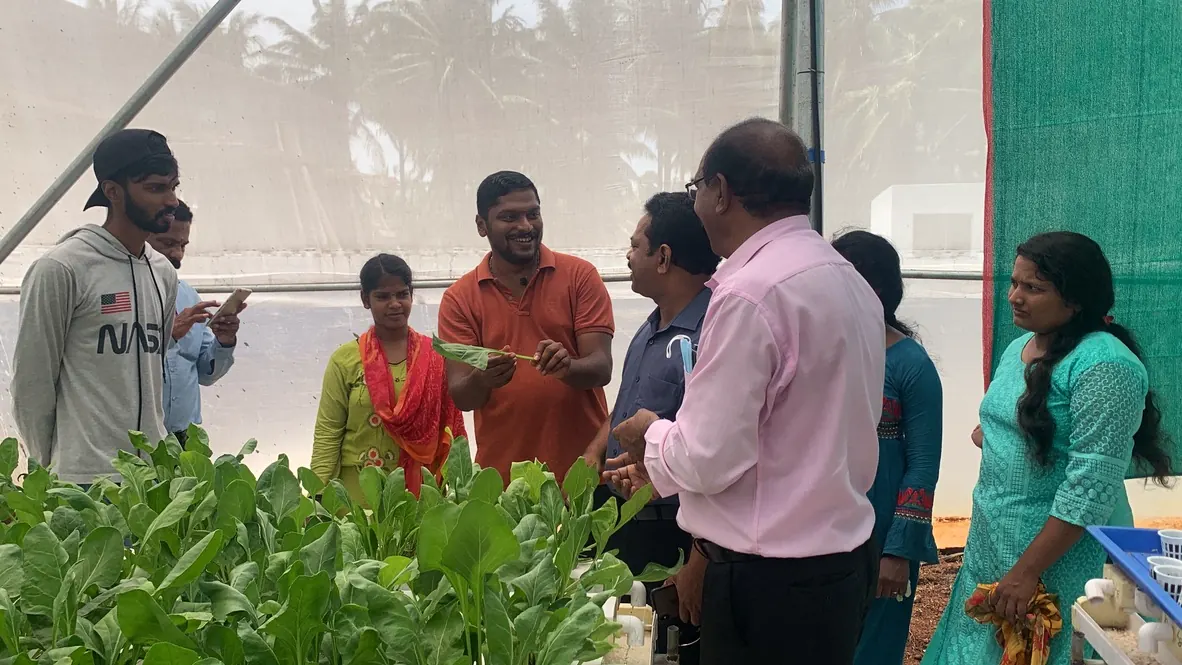
Polyhouse and hydroponic farming change faster than most syllabuses can follow. We close that gap with guest sessions, certified training, time on working farms, and a route into internships and jobs.
An MoU turns this from a one-off guest lecture into a program your students can plan around.
For years, agriculture graduates went into software.
An agricultural engineering graduate taking an IT job was the usual story. A working polyhouse today runs on sensors and automation, climate prediction, structural engineering, plant biology and nutrient chemistry, often all at once.
So the farm now needs graduates in electronics, computer science, AI and ML, mechanical, civil, physics, chemistry and biology.
We have not reversed a trend that is decades old. In three years: 13 colleges, 163 student internships and 11 placements. A few of the students placed now work abroad, and others have gone on to higher studies. It is a start.
What an MoU includes.
Each partnership is set for the college. Batch sizes, schedule and fees are agreed one college at a time. This is the full range we draw from.
- Training and certification. Structured programs built on the written procedures of working farms, with an industry assessment and a certificate at the end of each batch.
- Internships. Chosen on merit, with structured evaluation reported back to your college. 163 students so far. Not guaranteed.
- Placement support. Strong interns are considered for roles at Greenzy and other companies. 11 placed so far. Not guaranteed.
- Professor of Practice. If your college wants it, we nominate practitioners for Professor of Practice roles under the UGC scheme: teaching, mentoring and syllabus input. Optional.
- Faculty training and farm access. Time on working polyhouse and hydroponic farms for faculty as well as students, and training sessions for faculty.
- Applied research. We pick real industry problems together, with room to develop and patent jointly where a project earns it.
- Through the year. Masterclasses, industrial visits, hackathons, white papers and knowledge-sharing sessions, spread across the year.
- Campus Ambassadors. A paid role for shortlisted third and fourth year students, in any discipline. They run the official Greenzy WhatsApp group and represent Greenzy on campus. About the role
What we need from your side.
- Student screening. A set way to pick eligible, motivated students for each program, instead of an open call to the whole batch.
- A coordinator. One faculty member who keeps sessions, attendance and reporting on track.
- A room and audio-visual support. On the days we are on campus. Nothing specialised.
- A minimum batch. Enough students per session for the format to work. The number is agreed with each college.
- Keeping the dates. Sessions run on the agreed calendar. An MoU works best when both sides hold the dates they commit to.
- Shared reporting. Attendance and outcomes tracked together, so both sides can see what works each year.
How a partnership starts.
Questions colleges ask.
Is there a cost to the college?
The fee model is flexible: paid by the college, by students, or shared, worked out with each college. Whichever you choose, an MoU also gets your students a 100% fee waiver on the Greenzy Agri Hackathon.
Are internships or placements guaranteed?
No. They are chosen on merit, as in any real hiring. What your students do get is access: they are considered for roles most students never see. 163 have interned with us so far, and 11 have been placed.
How long is an MoU for?
It is agreed with each college. Most run for about a year and are renewed after a review. Longer terms are possible.
Do we need a polyhouse or hydroponics set-up?
No. We bring the procedures, the training material and, where relevant, access to equipment. You provide a room, audio-visual support and a coordinator.
Can students join the Agri Hackathon without an MoU?
Yes. Colleges with an MoU have the entry fee waived. Others can still enter: write to agrihackathon2026@greenzy.in.
What is a Professor of Practice, and do we have to use it?
It is a UGC-recognised role that lets industry practitioners take on defined teaching and mentoring at your college. It is optional. One of our colleges has asked us to set this up, and we expect more to follow.
Talk to us about your college.
We will walk you through what an awareness session looks like, a realistic schedule for your college, and what colleges near you already run with us.
The same team runs the Agri Hackathon 2026 and our work with 13 colleges in Coimbatore.