
The question.
Plants change inside before they look different. Can those changes be measured reliably, and early enough for a farmer to act? That is the whole question.
It is research. There is no product and nothing to buy.
The first trial, 20 Aug to 11 Sep 2026.
60 Italian basil plants in water culture, 20 to a tank, at 3 nitrogen levels: 150, 100 and 50 ppm. We recorded plant growth in 17 sessions and read how the leaves reflect light with a CI-710 spectrometer in 7 sessions.
What we found.
No nitrogen signal. What first looked like one came from the way we measured.
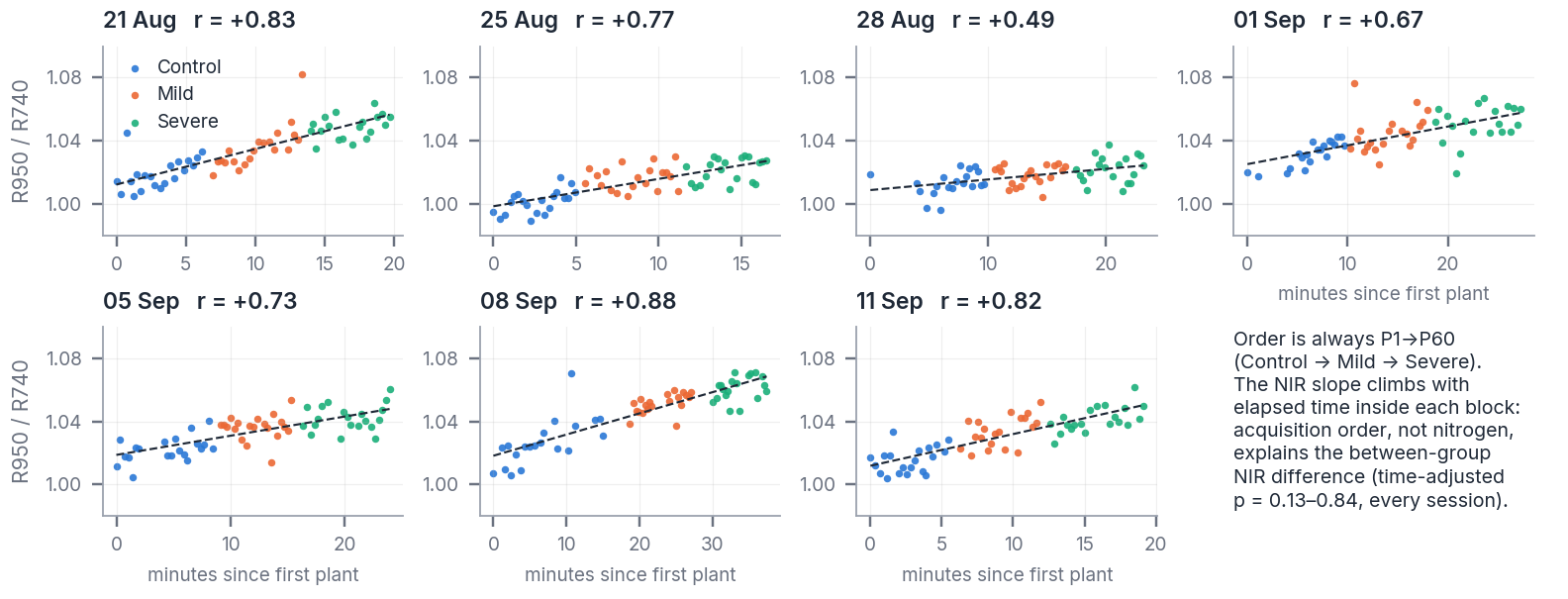
- The readings drifted with time. We always measured in the same order, plant 1 to plant 60, so the three groups were read at different minutes, and the reading climbs through every session. The raw difference between groups looked strong (p < 0.001) and went away once time was allowed for (p = 0.13 to 0.84). A classifier separated the groups with 82 to 92% accuracy, and with 100% using measurement time alone.
- The noise was too high. The same plant's reading barely agreed from one session to the next (r = −0.06 to +0.34).
- The plants were not short of nitrogen. The 50 ppm group showed no deficiency in 22 days. It grew 25.0 cm in height, against 22.6 cm at 150 ppm and 17.8 cm at 100 ppm.
- One tank per treatment was a design flaw. Tank pH fell to between 3.3 and 4.0 from 3 Sep, and the root zone reached 35 to 39 °C. With one tank each, the tank and the treatment cannot be told apart.
- Our records had errors. We threw out 14 impossible values, such as a leaf temperature of 280.7 °C.
What we can say
- How our instrument drifts, and how much noise it carries.
- What was wrong with the design.
- Checking the signal before adding anything complex was the right step, and it is done.
What we cannot say
- That leaf readings detect nitrogen deficiency.
- That any wavelength responds to nitrogen.
- That a change in readings comes before visible symptoms.
- Anything from a model built on this data. It would only learn the order we measured in, so we are not building one.
What changes in the next trial.
- Plants read in random order, by someone who does not know the treatment, at a fixed time of day
- The instrument warmed up and re-referenced every 10 or so plants, with 3 to 5 reads on a marked leaf
- 2 to 3 tanks per treatment or individual containers, and 3 to 5 days of baseline before the stress starts
- A wider nitrogen range, such as 150, 50 and 15 ppm, or a longer run
- SPAD readings, a visual score and leaf tissue tests, so that "early" and "nitrogen" each have something to be checked against
We will publish the next result here, including if it falls short.
“I would love to sell you an early-warning tool. We do not have one yet.”
Siva, founder